

Re-Membering Our Shared Future
To Speak from the Stars


The Impulse to Gather
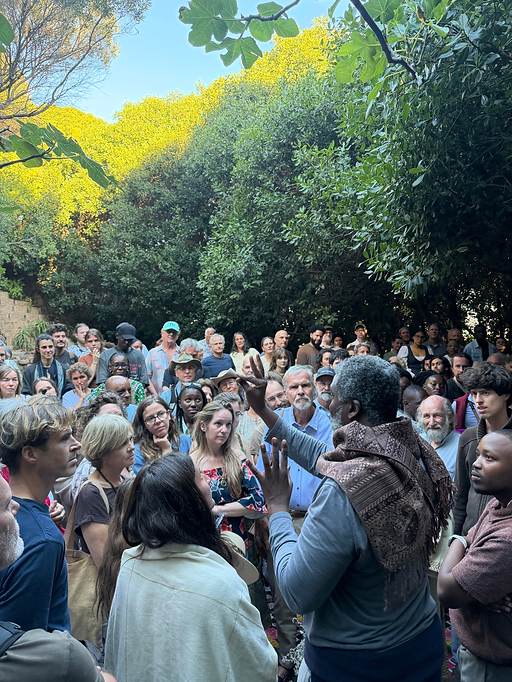
From 1–5 April 2026, Cape Town became the meeting place for people from across generations, cultures, traditions and continents, brought together around a question that is both ancient and very much of our time: what kind of future are we called to remember and create together?
Re-Membering Our Shared Future: To Speak from the Stars grew from a network of people meeting regularly to explore how spiritual and social renewal might take root in the present. Within these conversations, younger people had voiced a need for spaces where they could meet counterparts across generations and where new forms of leadership might emerge through creativity, listening and relationship. The gathering was conceived as a meeting place for these questions, rather than a place in which they would be resolved.
At the heart of the gathering was a wish to bring two powerful streams into dialogue: the work of Rudolf Steiner and the legacy of Vusamazulu Credo Mutwa. The intention was not to collapse their differences, but to create a space where different cultural and spiritual streams could meet, listen to one another and perhaps discover something that could not have emerged from either stream alone. The human being, standing between heaven and earth, became one of the central images through which this exploration unfolded.
The gathering was designed to be lived. Art, conversation, movement, storytelling, spiritual practice, nature and community life were woven through the five days. The hope was that what was experienced would not remain at the level of ideas, but could be carried home and woven into the communities from which people had come.
People came from every continent, bringing different histories, cultures, practices, questions and ways of seeing. The diversity of age, culture, experience and spiritual background was not incidental. It was part of the purpose of the gathering: to create the conditions for genuine encounter between people who might otherwise never have shared the same circle.


Continuing the Gathering into the Future
The impulse continues online via Zoom on the last Wednesday of every month. Should you wish to join us for these gatherings, please email rememberingoursharedfuture@gmail.com for the details.


Orland Bishop
Originally from Guyana, South America, Orland Bishop immigrated to Los Angeles by way of Brooklyn as a teenager. A community organizer, philosopher, healer and teacher, Orland Bishop works within a global social network of individuals and agencies engaged with the Ecology of Nature and Human Consciousness within the realms of life and death. His work in healing and human development is framed by an extensive study of medicine, psychology, naturopathy, phenomenology and indigenous cosmologies, primarily those of South and West Africa.
He is the Co-Founder of Shade Tree Multicultural Foundation, a Los Angeles-based organization dedicated to creating agreements of the heart for societal development where he focuses on mentoring youth and fostering social change through spiritual practices. Orland aims his work toward the development of consciousness and healing of cultures. His approach often involves bridging ancestral wisdom with visions of the future. He is the author of The Seventh Shrine: Heart Cognitions on the African Spiritual Journey.

Maaianne co-founded Kufunda Learning Village in Zimbabwe, nurturing community resilience, Waldorf education, biodynamic farming and transformative leadership through locally rooted, collaborative learning.

Joan Sleigh
Joan is Director of OASA and Acting Managing Director of the Centre for Creative Education, with a background in Waldorf education, anthroposophy and leadership development.

Edgard Gouveia Jr
Edgard Gouveia Jr is an architect, urbanist and social innovator who uses cooperative games and collective action to inspire youth-led community regeneration and social change.

Rutendo L Ngara
Rutendo Lerato Ngara is a Southern African scholar and Indigenous Knowledge Systems practitioner bridging science, healing, ancestral wisdom and regenerative futures.

Makhosi VulaMasango
Isis Nozipho Mutwa
Makhosi VulaMasango is a Doctor of African Traditional Healing, Gobela and founder advancing indigenous healing, ancestral knowledge and African cultural heritage.

Janet Manoni
Janet Manoni is an anthroposophist, children’s health activist and founder of Mwanangu Development Tanzania, advocating for equitable access to healthcare and Waldorf education.

Dr. Nkosenathi Koela
Dr Nkosenathi E. Koela is a South African scholar, sound artist and initiated Gqirha healer exploring the intersections of sound, technology, Indigenous knowledge and healing.

Gershan Lombard
Gershan is a Khoi and San-descended musician and storyteller, weaving ancient Indigenous sounds, ceremonial music and ancestral wisdom into healing experiences.

Sue Davidoff
Sue works out of The Proteus Initiative, an organisation dedicated to an ecological vision of social life, engaged in practices, processes and methods that approach social situations with an enlivened and organic way of thinking.

Ezra Sullivan
Ezra Sullivan works in spiritual research, social entrepreneurship and organisational consulting, focusing on renewing the relevance of the Anthroposophical Movement.

Anne-Lise Bure
A leader in Ubuntu-inspired social development, Anne-Lise is CEO of the Novalis Ubuntu Institute, advancing human flourishing, harmony and shared futures.

Khalil Rossouw
Khalil Rossouw is an arts facilitator and OASA coordinator with a background in theatre, dance, music and online facilitation, guided by anthroposophy and social art.
Each gathering leaves something with us, often in ways that take time to find words for. To explore these reflections more deeply and encounter the experience through the eyes of those who took part, you are warmly invited to read the full written reflection here.

What We Carry Forward
There was a sense throughout the gathering that we were not there simply to talk about the future but to begin practising a different way of meeting it. This happened in the way the generations met one another, in the willingness to bring different spiritual and cultural traditions into conversation, and in the many forms of art and shared practice that allowed people to encounter one another beyond words.
Perhaps this is what the gathering leaves us with. Not a finished picture of what a shared future should look like, but a stronger sense of the conditions in which one might begin to take shape: spaces where questions can be held, where different kinds of knowledge can meet, where young people can bring their voices, where those with more years of life experience can listen and share what they have learnt, and where there is enough openness for something unexpected to emerge.
The gathering also reminded us that this kind of work takes time. Five days can create an opening, but it cannot complete the work. The relationships formed in Cape Town, the questions that were raised and the experiences that were shared now have to find their way into the lives and communities of those who were part of it.
This is already happening. The Shared Future continues through monthly online meetings and in-person gatherings in Cape Town, while communities connected to the work are growing elsewhere in Africa and in the United States. New conversations and collaborations are emerging, and the original circle is beginning to take on new forms.
What we carry forward, then, is not only the memory of the gathering itself. It is the experience of having created a space in which different generations, cultures and traditions could meet with one another, and the recognition that something can begin when we make that space